
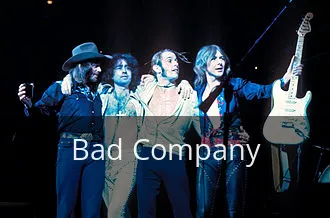
Ever crank up “Feel Like Makin’ Love” or “Bad Company” and just feel that classic rock swagger?
Good.
But hold on a second.
Before you dive deep into their legendary catalog, there are some truly surprising, almost unbelievable, truths about Bad Company that will completely change how you hear their music and understand their legacy.
Are you ready to unveil the three secrets that make Bad Company even more fascinating?
Secret #1: They Were the Anti-Supergroup Supergroup

You know Bad Company was made up of rock royalty: Paul Rodgers (Free), Mick Ralphs (Mott the Hoople), Boz Burrell (King Crimson), and Simon Kirke (Free).
Sounds like a recipe for a massive, self-indulgent supergroup, right?
Wrong.
While other supergroups of the era often embraced theatricality and progressive excess, Bad Company deliberately went the other way.
Their mission was simple: strip it down, make it raw, and focus on pure, unadulterated rock and roll groove.
They actively downplayed their individual pedigrees, wanting the music to speak for itself, rather than riding on past glories.
This commitment to no-frills rock, despite their incredible collective talent, is truly remarkable and foundational to their sound.
Secret #2: Led Zeppelin’s Firstborn (and Favorite?)

Most rock fans know Bad Company was signed to Swan Song Records, Led Zeppelin’s own label.
But here’s the mind-blower: Bad Company was not just *a* band on Swan Song; they were the very first act signed to the label.
Think about that for a moment.
Jimmy Page and Robert Plant, at the absolute height of their power, put their immense trust and resources into Bad Company first, even before other legendary artists.
This wasn’t just a business deal; it was a stamp of approval, an endorsement from the gods of rock themselves, and it meant Bad Company had unparalleled artistic freedom and support to forge their unique, no-nonsense sound.
It’s a testament to the sheer magnetism and talent of the band that Zeppelin chose them to kick off their ambitious new venture.
Secret #3: Their Name Came from an Obscure Western Film

The name “Bad Company” sounds inherently cool, like a rebellious, outlaw gang of musicians, right?
And it is!
But its origin is even more unexpected: it came from a 1972 Western film starring Jeff Bridges.
Paul Rodgers supposedly saw the movie poster and was struck by the title and its gritty, independent vibe.
This wasn’t just a catchy name; it became the band’s ethos.
The idea of being “bad company” – in the sense of being an outsider, an unconventional force – perfectly mirrored their deliberate rejection of rock star excesses and their focus on honest, straightforward rock.
It solidified their identity as musical gunslingers, doing things their own way.
So, the next time you hear a Bad Company track, remember these three secrets.
They weren’t just a supergroup; they were the anti-supergroup.
They weren’t just signed by Zeppelin; they were the chosen ones.
And their iconic name wasn’t random; it was a blueprint for their outlaw spirit.
Doesn’t that make their music sound even better?
The Unexpected Encore

Ever wonder how a rock legend unwinds after a blistering gig?
It’s late, the tour bus rumbles down the highway, and Paul Rodgers, the unmistakable voice of Bad Company, finds himself restless.
He’d just pulled off another electrifying performance, but now, the adrenaline was fading, leaving only the quiet hum of the road.
Rummaging through a forgotten flight case, half-expecting an old lyric book or a misplaced harmonica, his fingers brushed against something small, smooth, and utterly unexpected.
It was a device no bigger than a soda can – a Portable Projector.
“What in the blazes is this?” he murmured, a faint smile touching his lips.
Turns out, one of the roadies had left it behind, and curiosity, as they say, killed the cat, but in this case, it resurrected a memory.
Paul connected his phone, the screen flickering to life, displaying the model name: a Nebula Capsule 3 Laser Portable Projector.
With a gentle click, a familiar image burst onto the beige wall of the bus: a grainy, exhilarating clip of a younger Bad Company, live on stage, decades ago.
The sound, surprisingly rich, filled the small space, and for a few precious minutes, the legendary frontman was just a man, lost in the raw energy of his own past.
No stadium, no spotlights, just the quiet hum of the bus and the luminous echoes of a lifetime of music.
It was a moment of pure, unadulterated joy, a private encore brought to him by something so simple, yet so profoundly impactful.
Who knew such a tiny gadget could deliver such a monumental feeling?
[music_from band=”Bad Company”]
Leave a Reply