
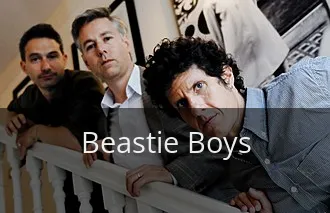
Think the Beastie Boys were just about party anthems and playful rebellion?
Think again.
Beneath the surface of their groundbreaking beats and irreverent rhymes lies a surprising layer of foresight, almost as if they were channeling future societal shifts and technological changes decades before they hit.
Prepare to have your mind blown as we dig into 7 specific Beastie Boys lyrics that seem to have secretly predicted the future, making you rethink everything you thought you knew about Ad-Rock, MCA, and Mike D.
More Than Just Party Anthems?

Let’s kick things off with a profound statement that landed long before its cultural echo.
In 1994, they dropped “Sure Shot” with the iconic line: “I want to say something that’s long overdue. The disrespect to women has got to be through.”
At a time when misogyny was rampant in many music genres, this wasn’t just a progressive stance; it was a rallying cry that eerily foreshadowed movements like #MeToo, pushing for accountability and respect in the years to come.
It’s almost as if they were setting the stage for a conversation the world desperately needed to have.
Then consider “Remote Control” from 1998, where they rapped: “The television is controlling me.”
While originally a nod to passive media consumption, how much more potent is that line in our current age of personalized algorithms, endless scrolling, and social media dictating our very thoughts?
We are, arguably, more “controlled” by screens now than ever before, unknowingly influenced by digital forces shaping our realities.
The Relentless March of Culture

Remember 1986’s “No Sleep Till Brooklyn”?
The entire track is an anthem of relentless touring and the grind of the music industry: “No sleep till Brooklyn!”
Doesn’t that sound like the pre-cursor to today’s pervasive “hustle culture” that demands constant productivity, glorifies burnout, and insists you’re always “on,” striving for success no matter the personal cost?
It was a lifestyle, but now it’s a societal mandate.
And what about “Sabotage” from 1994, a song born from frustrations with their record label?
The feeling of being undermined or targeted, encapsulated by lines like, “I can’t stand it, I know you planned it,” resonates deeply with the modern era of online misinformation and “cancel culture.”
The pervasive feeling of distrust, of unseen forces plotting, and the rapid spread of accusations online often mirror the raw emotion of that track.
A Glimpse Into the Digital Wild West

Rewind to “Rhymin’ & Stealin’” from 1986, where they declared their pirate-like freedom: “We’re sailing the seas, we’re doing what we please.”
Beyond its literal context, doesn’t this perfectly encapsulate the early, wild west days of the internet, where file-sharing and content creation ran rampant, often outside traditional legal or corporate structures?
It was a new frontier, indeed, where everyone could “do what they please” with digital content.
Then there’s the defiant individualism of “So What’cha Want” (1992), specifically the vibe of “I’m a funky brother, yes I am!”
This fierce self-assertion and demand for authenticity feels like a prophetic nod to the rise of personal branding and influencer culture.
In a world saturated with content, everyone is now tasked with asserting their unique “funk” to stand out.
Finally, consider the abstract “Body Movin’” from 1998 with its haunting line: “Like a bad dream, you can’t wake up from.”
In our hyper-connected, often overwhelming digital landscape, isn’t this the perfect metaphor for doomscrolling, the endless news cycle, or the feeling of being perpetually entangled in online chaos?
From social justice to digital addiction, the Beastie Boys, it seems, were not just creating timeless music; they were inadvertently holding up a mirror to a future none of us could quite see.
Their lyrics, often playful or rebellious, contained unexpected depths and uncanny prescience.
So, the next time you drop the needle on a Beastie Boys record, listen a little closer.
You might just hear the echoes of tomorrow.
When the City Goes Quiet: Ad-Rock’s Unexpected Serenity

Ever tried to write a catchy riff with a symphony of sirens as your backup band?
For someone who helped define the sound of a generation with the Beastie Boys, Ad-Rock knew noise.
But even he reached his limit in his bustling Brooklyn apartment.
The city’s constant hum, the honking cabs, the drilling – it was a creative buzzkill.
He’d tried everything from noise-canceling headphones to shouting at pigeons.
Then, a friend mentioned a “white noise generator,” a strange concept to a guy who usually embraced chaos.
Skeptical, he ordered a LectroFan Evo, not expecting much.
It looked unassuming, just a small, sleek disc.
He plugged it in, selected a fan sound, and a subtle, consistent whoosh filled his room.
Suddenly, the outside world faded, replaced by a soothing, private hum.
It wasn’t silence, but a gentle sonic blanket that just… worked.
His mind, usually buzzing with distractions, found a quiet corner to play.
That evening, a new bassline, fluid and inspired, finally emerged from the stillness.
Sleep followed, deep and unbroken, for the first time in ages.
Who knew a simple sound machine could be a secret weapon against urban overload?
It offered unexpected tranquility, proving even legendary musicians need a little peace.
While this is just a fun, imaginative tale for the fans, perhaps there’s a universal truth here.
Finding your quiet space, whether with a gadget or a moment of reflection, is pure genius.
[music_from band=”Beastie Boys”]
Leave a Reply