
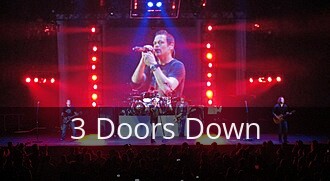
Imagine a world where your favorite rock anthem, the one you belt out in the car, suddenly vanishes from the airwaves.
It’s not about explicit lyrics or rebellious themes.
It’s about something far more profound and heartbreaking.
Today, we’re diving deep into the untold story behind the 3 Doors Down song that wasn’t officially “banned,” but faced a startling level of self-censorship and removal from radio playlists after a tragedy that shook the world.
Are you ready to discover the chilling “why” behind the temporary silence of one of their biggest hits?
The Unthinkable Reason Behind “Kryptonite’s” Brief Vanishing Act
You know “Kryptonite,” right?
It’s the song that launched 3 Doors Down into superstardom, an iconic track synonymous with early 2000s rock.
But did you know that in the immediate aftermath of September 11, 2001, this powerhouse hit was pulled from the airwaves by many radio stations across America?
Yes, the very song about self-reliance and unexpected heroism became a casualty of national trauma.
It wasn’t because of its themes of power or vulnerability in a superhero context.
The reason was far more sensitive, stemming from specific, seemingly innocuous lyrics that suddenly took on a terrifying new meaning.
When Lyrics Take on a Chilling New Meaning Post-9/11
The core of the controversy revolved around a single, haunting line: “I don’t stand too close to the edge.”
This seemingly innocent lyric, combined with the later mention of “jump,” struck a raw, painful nerve in the wake of the 9/11 attacks, particularly the horrific images of people tragically falling or jumping from the World Trade Center towers.
In a nation gripped by shock and grief, radio stations, out of an abundance of caution and respect for the victims and their families, began to quietly remove songs that could evoke such painful imagery.
It wasn’t a governmental ban, nor was it a statement against the band or the song’s true message.
It was a visceral, public reaction to unspeakable horror, where even a metaphor about personal limits became too much to bear.
The band, of course, never intended this tragic association, but the world had irrevocably changed.
The Lingering Echoes: Why This Story Matters
While “Kryptonite” quickly returned to its rightful place as a rock staple, this brief period of self-censorship offers a powerful, albeit somber, lesson.
It highlights how art, even the most beloved and seemingly benign, can become deeply intertwined with real-world events and collective trauma.
For fans, understanding this hidden chapter adds an incredible layer of depth to an already iconic song.
It’s a poignant reminder of a time when the very air we breathed felt different, and how even music had to adapt to a changed reality.
It shows us the profound sensitivity and responsibility that came with broadcasting during one of America’s darkest hours.
So, the next time you hear “Kryptonite,” remember its full story.
It’s not just a song about a hero losing his power; it’s also a quiet testament to a nation’s grief and the unexpected ways tragedy can ripple through our culture, even touching the music we love.
Isn’t it incredible how much untold history can hide within a three-minute track?
Even Rock Stars Need a Moment of Quiet.
Imagine the roar of thousands, the pulsating bass, the pure adrenaline of a 3 Doors Down concert.
For Brad Arnold, the band’s frontman, that’s just another Tuesday night on the road.
But what happens when the amps go silent, and the arena empties?
The tour bus becomes a rolling symphony of engines, road noise, and the muffled chatter of a tired crew.
It’s a world that rarely slows down, yet everyone, even a rock star, needs a sanctuary, right?
Brad, known for his powerful vocals and heartfelt lyrics, truly cherishes those rare moments of solitude.
His secret weapon against the constant hustle? His trusty
Sony WH-1000XM5 Noise-Cancelling Headphones.
Picture this: late night, miles blurring outside the window, the bus rumbling like a restless beast.
Instead of the relentless drone, Brad slips on his Audio Headphones, and a profound, almost tangible, silence descends.
It’s not just quiet; it’s an immediate, almost spiritual hush that washes over him, creating a private bubble.
Suddenly, the world shrinks to just him and his chosen soundtrack.
Sometimes, it’s a surprisingly calming classical piece; other times, an obscure podcast about deep-sea exploration, miles away from rock anthems.
This isn’t just about blocking noise; it’s about reclaiming mental space, finding focus, or simply unwinding after a high-octane performance.
Do you ever wish you could hit a pause button on your noisy commute or a chaotic workday?
Brad’s fictional experience isn’t so different from yours, proving that even amidst rock ‘n’ roll chaos, true peace is just a pair of headphones away.
Leave a Reply